
I find myself in a state of lethargy. While I’m trying my best to catch up with deadlines, I cannot seem to work myself up to any sense of urgency. The littlest of things could get me crying, which is truly surprising. I’m not that kind of person, or so I thought. What I need is a project, and I figure what better way to get my juices pumping again than to work on this blog. As a start, I’m going to fill this up with stuff I’ve written through the years, because there’s quite a lot! It would be a nice way to jog my memories as well.
I wrote this piece for a newsletter, for Bacolod if I’m not mistaken. I got to interview one of the breeders via phone, and even heard the cocks crowing in the background!
Here goes…
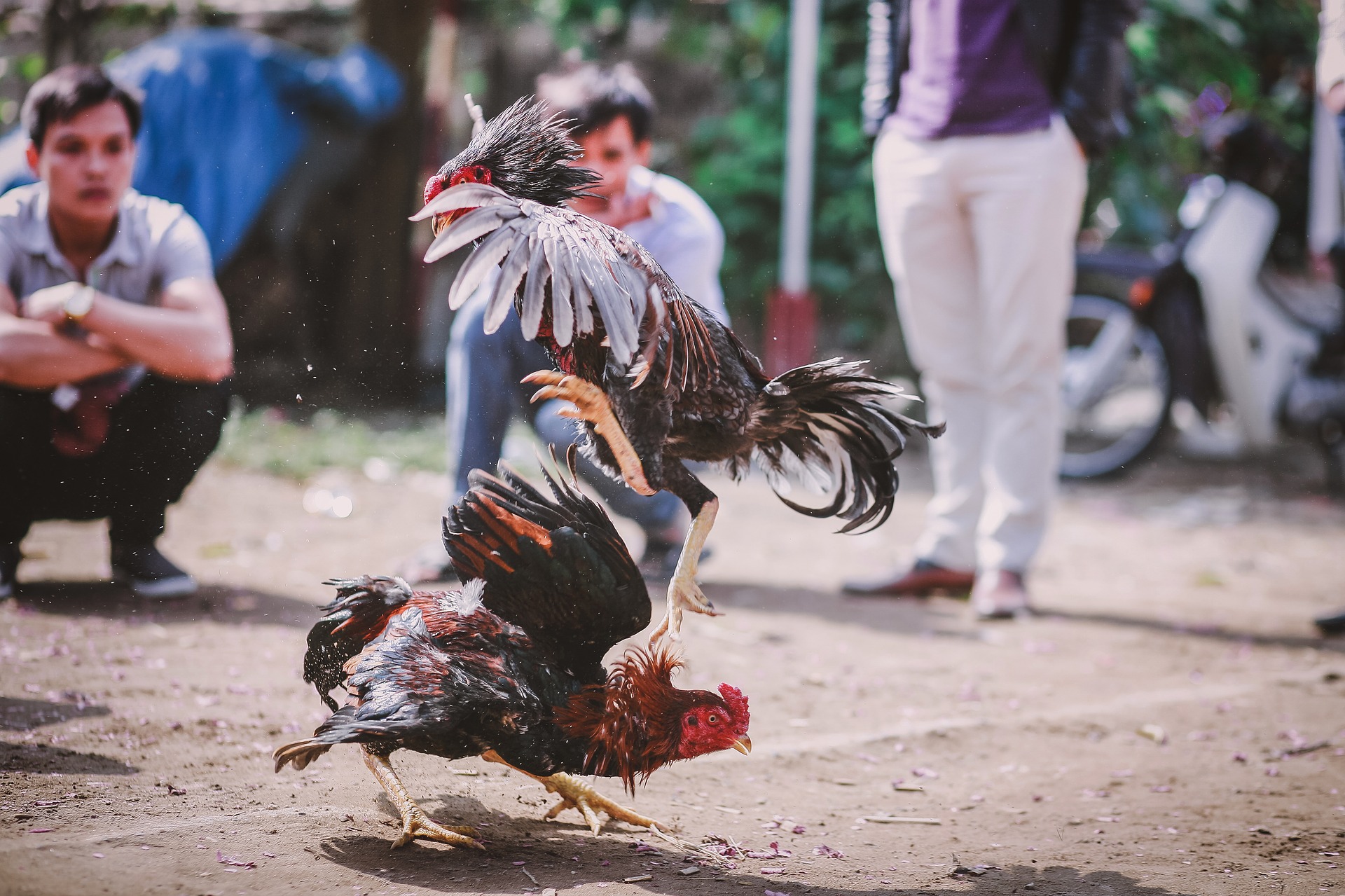 It is probably one of the most brutal sporting events that one will ever get the chance to witness. Two opponents, bred and born to kill, meet each other in a battle to the death. Their extremities armed with claws of lethal strength, they split, stab, pierce, and mangle each other until one or the other is drenched in blood, its life ebbing away with every cut and splice. Amidst all this bloodletting, the crowd rips and roars, encouraging each swift movement of the gladiators. In the end, only one is left standing, the other, in some places, carried away from the arena and dropped in a vat of boiling water; an unfortunate end to one who fought for its life so fiercely and so ferociously.
This is the world of cockfighting.
Second only to basketball, cockfighting is a most popular sport in the Philippines. Every town and city has a cockpit where men of different occupations and socio-economic orientations gather together to watch this brutal sport. It is, as they say, a great leveler with farmers and landowners standing alongside each other in the spirit of pure entertainment.
While one can find breeders, trainers, and handlers in virtually every part of the country, none are quite as good as those found in Negros. Here, cockfighting is big business. It is believed that about 150,000 heads of game fowl are shipped out of Negros to various parts of the country every year, making it a multi-million peso industry. Take in all the other complementary businesses that spring from it, from chicken feeds and scratch pens to digital thermometers, and you’ve got one burgeoning business.
During the heyday of the sugar industry, raising roosters was a natural inclination for the Negrenses. As they waited for their sugar canes to mature, they took care of their roosters, raising them into fine form. When American breeder Duke Halsey brought the lemon hackled red battle fowl into the country in the sixties, breeding reached another level in the Philippines. And it didn’t take long for local breeders, notably those from Negros, to come up with their own competitive bloodlines. Indeed, most fighting cocks today are bred and raised in Negros.
Growing up in a farm, Paeng Araneta quickly grew a liking to roosters. It was he would eventually make the legendary Lemon 84 bloodline, which won the international derby in 1972. Another prominent breeder, Gerardo Veloso, became interested in cockfighting in the same way that Paeng did. He says, “As a young child in my father’s home, I grew up with lots of chicken in the house.”
How the Negrenses came to be such prolific breeders was but a natural thing, says Paeng. Negros was rife with these agricultural animals, which thrived well in the province’s rich soil and good weather. Gerard adds, “The Negrenses always had the time. They always had it in them.”
In order to raise good fighting roosters, Paeng says that one has to start from good stock. It must have the proper parents. Gerard adds, “It’s important to have authentic bloodlines.”
“They are beautiful creatures,” says Paeng. And through the years, this gentleman from Negros has developed a warm affection for them, a characteristic common to most breeders, who pour in time and effort to train their roosters into fighting form.
Cocks are prepared for fights in the same way that boxers are trained for their matches, Paeng says. They must be able to grow the proper muscle, be well-nourished, and stand at the peak of health.
When Gerard was younger, he joined the National Cockers Association and participated in derbies in different parts of the country. In Negros, annual stag derbies are staged by the Negros Gamefowl Breeders Association (NGBA) and the Gamefowl Breeders Association of Negros (GF-BAN) to coincide with the Masskara Festival in October. Nationwide, there is a game pit in almost every barangay with anywhere from seven to 13 million cocks going on mortal combat every year. For big time fights, the prize runs to the millions.
Such fights, Gerard says, attract all kinds of people. But because the industry as a whole has become too big, he says, “Nobody can dominate cockfighting anymore.”
Paeng was never much of a gambler, concentrating instead on caring for his roosters. But though he may sometimes get attached to his roosters, he knows that they are intrinsically warriors. He says, “That is their reason for being, fighting.”
Gerard says of his roosters: “I love them.”
When he is feeling bad or depressed, Gerard likes going to his farm. Tending to his roosters not only calms him down, it makes him happy as well. There is also a sense of fulfillment that he is raising roosters to win!



 LULA LAND
Leave a comment